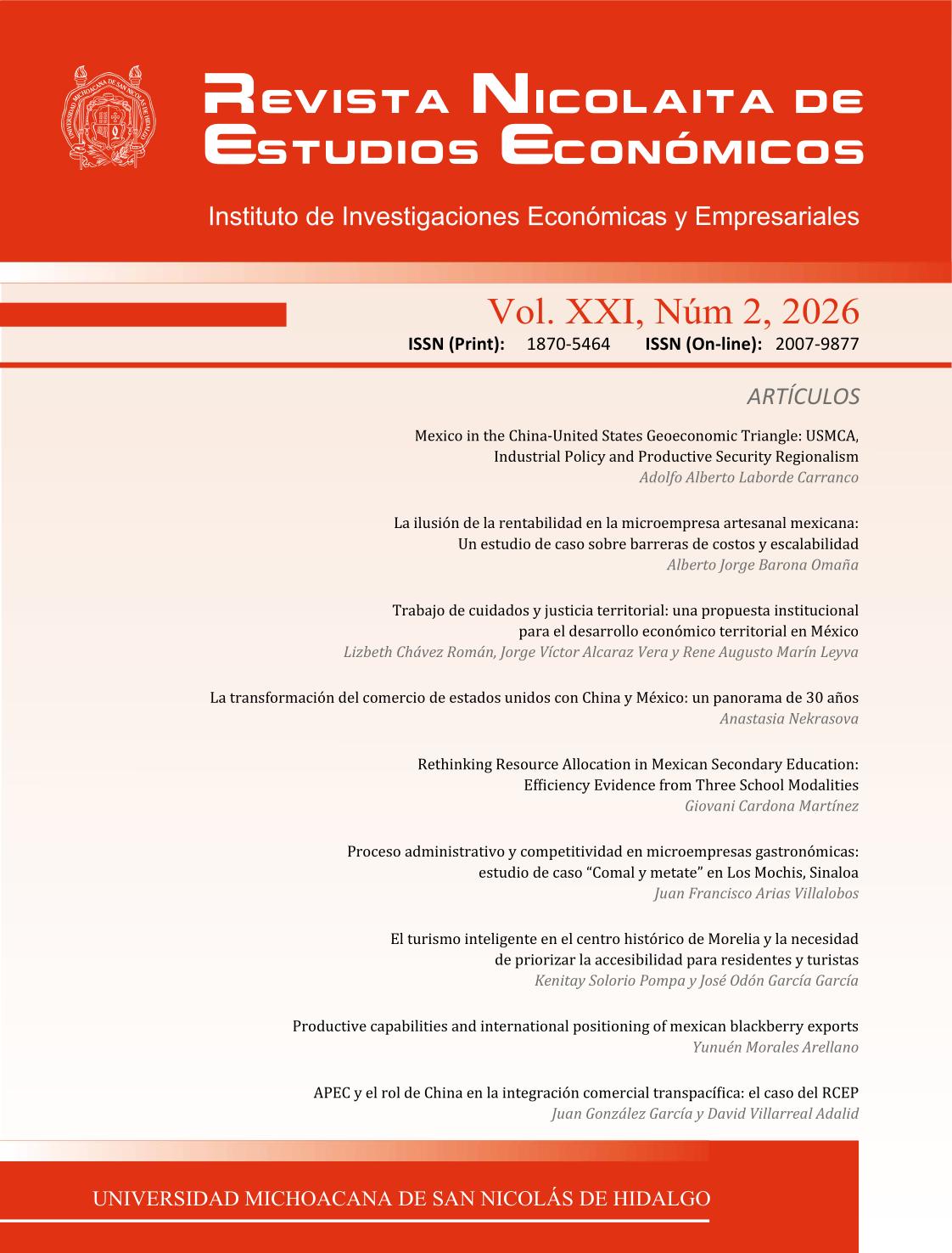
México en el triángulo geoeconómico China-Estados Unidos: TMEC, política industrial y regionalismo productivo de seguridad
DOI:
https://doi.org/10.33110/rnee.v21i2.387Palabras clave:
México-China, T-MEC, geoeconomía, cadenas globales de valor, política industrial, Iniciativa de la Franja y la Ruta, regionalismo de seguridad, nearshoringResumen
Este artículo examina la relación económica entre México y China en el contexto de la rivalidad geoeconómica entre Estados Unidos y China, la política arancelaria estadounidense y la revisión de 2026 del Tratado entre México, Estados Unidos y Canadá (T-MEC). El argumento central sostiene que México enfrenta una doble transición: por un lado, la oportunidad de beneficiarse de la reconfiguración de las cadenas de suministro, el nearshoring y la demanda norteamericana de bienes manufacturados; por otro, el riesgo de convertirse en un canal para la triangulación de insumos chinos dentro de un régimen regional cada vez más organizado en torno a la seguridad económica, la trazabilidad y el origen confiable. A partir de un estudio de caso cualitativo, datos comerciales de 2021-2025 y una revisión del estado del arte sobre cadenas globales de valor, política industrial, geoeconomía, Estado desarrollista, la Iniciativa de la Franja y la Ruta, y regionalismo de seguridad, el artículo introduce el concepto de regionalismo productivo de seguridad para explicar la nueva fase de gobernanza del T-MEC. La contribución teórica consiste en vincular la literatura sobre interdependencia armada y seguridad económica con los debates latinoamericanos sobre autonomía, desarrollo y política industrial. El artículo concluye que México no debe replicar el modelo chino ni incorporarse mecánicamente a la Iniciativa de la Franja y la Ruta. En su lugar, debe construir una estrategia propia de industrialización selectiva, infraestructura logística, cumplimiento de reglas de origen, diversificación asiática y coordinación entre el Estado y el sector empresarial.
Descargas
Citas
Amsden, A. H. (1989). Asia’s next giant: South Korea and late industrialization. Oxford University Press.
Baldwin, R. (2016). The great convergence: Information technology and the new globalization. Harvard University Press.
Baldwin, R. (2022). Globotics and macroeconomics: Globalisation and automation of the service sector.
Oxford Review of Economic Policy, 38(1), 70-92.
Blackwill, R. D., & Harris, J. M. (2016). War by other means: Geoeconomics and statecraft. Harvard University Press.
Boston University Global Development Policy Center. (2025). China-Latin America and the Caribbean economic bulletin: 2025 edition. Accessed June 23, 2026.
Cardoso, F. H., & Faletto, E. (1979). Dependency and development in Latin America. University of California Press.
Chang, H.-J. (2002). Kicking away the ladder: Development strategy in historical perspective. Anthem Press.
CSIS. (2025). USMCA review 2026. Center for Strategic and International Studies. Accessed June 23, 2026.
Dallas Fed. (2025). China remains a modest player in U.S.-Mexico trade despite growth in Mexico-China flows. Federal Reserve Bank of Dallas. Accessed June 23, 2026.
Data Mexico. (2025). China: Foreign trade, investments, migration and remittances. Secretaria de Economia. Accessed June 23, 2026.
Dubois, A., & Gadde, L.-E. (2002). Systematic combining: An abductive approach to case research. Journal of Business Research, 55(7), 553-560.
Dussel Peters, E. (2025a). Monitor de la OFDI china en América Latina y el Caribe 2025. Red ALC-China.
Dussel Peters, E. (2025b). Latin America, China, and great power competition: New triangular relationships. Lynne Rienner Publishers.
Evans, P. (1995). Embedded autonomy: States and industrial transformation. Princeton University Press.
Fajnzylber, F. (1990). Industrialización en América Latina: de la caja negra al casillero vacío. CEPAL.
Farrell, H., & Newman, A. L. (2019). Weaponized interdependence: How global economic networks shape state coercion. International Security, 44(1), 42-79.
Gereffi, G. (1994). The organization of buyer-driven global commodity chains. In G. Gereffi & M. Korzeniewicz
(Eds.), Commodity chains and global capitalism. Praeger.
Gereffi, G. (2025). Navigating industrial policy and global value chains in an era of geopolitical uncertainty. Journal of International Business Policy.
Hirschman, A. O. (1945). National power and the structure of foreign trade. University of California Press.
Juhasz, R., Lane, N., & Rodrik, D. (2024). The new economics of industrial policy. Annual Review of Economics, 16, 213-242.
Keohane, R. O., & Nye, J. S. (1977). Power and interdependence. Little, Brown.
Mazzucato, M. (2013). The entrepreneurial state. Anthem Press.
Mazzucato, M. (2021). Mission economy: A moonshot guide to changing capitalism. Harper Business.
Ministry of Commerce of the People’s Republic of China. (2026). Spokesperson’s remarks on Mexico’s Chinarelated restrictive measures. Accessed June 23, 2026.
OECD. (2025). OECD supply chain resilience review: Navigating risks. Accessed June 23, 2026.
Office of the United States Trade Representative. (2026a). United States and Mexico launch review process for the USMCA. Accessed June 23, 2026.
Office of the United States Trade Representative. (2026b). United States and Mexico announce next steps in bilateral discussions in advance of the USMCA joint review. Accessed June 23, 2026.
Prebisch, R. (1950). The economic development of Latin America and its principal problems. United Nations.
Rodrik, D. (2004). Industrial policy for the twenty-first century. Harvard University.
Rodrik, D. (2014). Green industrial policy. Oxford Review of Economic Policy, 30(3), 469-491.
Strange, S. (1988). States and markets. Pinter.
Timmermans, S., & Tavory, I. (2012). Theory construction in qualitative research: From grounded theory to abductive analysis. Sociological Theory, 30(3), 167-186.
U.S. Census Bureau. (2026). U.S. trade in goods with China, annual totals 2021-2025. Accessed June 23, 2026.
U.S. Department of the Treasury. (2026). Readout from Secretary Scott Bessent’s meeting with Mexican Secretary of Finance Edgar Amador Zamora. Accessed June 23, 2026.
Wade, R. (1990). Governing the market: Economic theory and the role of government in East Asian industrialization. Princeton University Press.
World Bank. (2025). World development indicators: China and Mexico, 2024 data. Accessed June 23, 2026.
World Trade Organization. (2025). Global value chain development report 2025: Resilience and reglobalization. Accessed June 23, 2026.
Descargas
Publicado
Cómo citar
Número
Sección
Licencia
Derechos de autor 2026 Adolfo Alberto Laborde Carranco

Esta obra está bajo una licencia internacional Creative Commons Atribución-NoComercial-SinDerivadas 4.0.