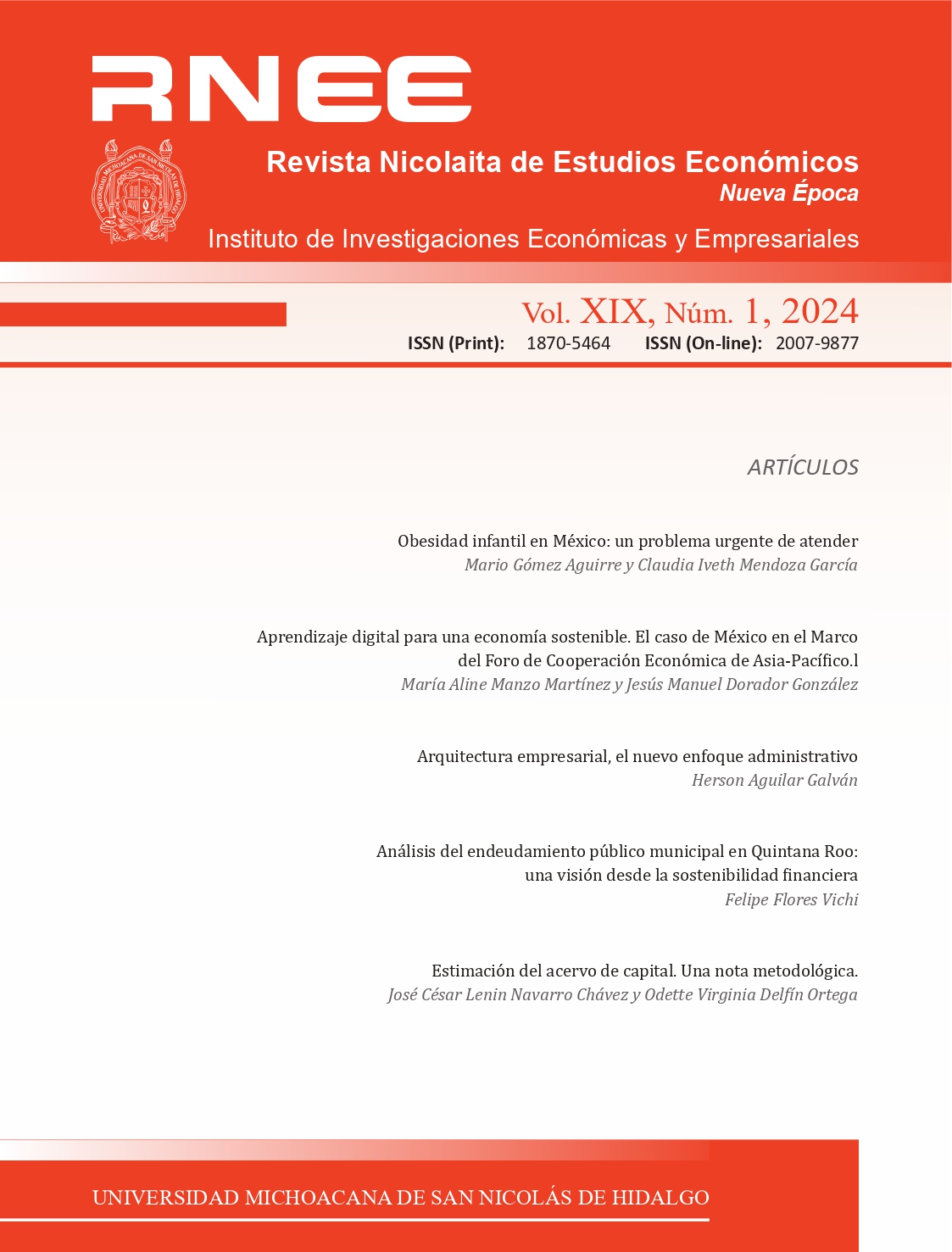
Aprendizaje digital para una economía sostenible. El caso de México en el Marco del Foro de Cooperación Económica de Asia-Pacífico
DOI:
https://doi.org/10.33110/rneev19i1.351Keywords:
Digital economy, digital learning, digital skills, green skills, Mexico, APEC economiesAbstract
Digital economy models integrate some crucial concepts in a structure where the value proposition of a product/service reects environmental protection, social impact and the integration of digital technologies in the processes of companies and government agencies. Through a theoretical review, this work aims to identify the concepts by which the digital learning of Mexico and the economies of the Asia-Pacic Economic Cooperation (APEC) can be measured to determine the support and speed that each government promotes to consolidate the digital economy model. Digital skills and green skills must be integrated into the digital transformation process of these economies, since it is through these skills that the prole of the countries which integrate the APEC will be able to apply and develop sustainable technologies that guarantee a competitive position in the global market and the region.
Downloads
References
Asia-Pacic Economic Cooperation (APEC) webpage. (2023). Digital Economy Steering Group. Disponible en: https://www.apec.org/groups/committee-on-trade-and-investment/digital-economy-steering-group
Auktor, G. V. (2020). Green industrial skills for a sustainable future. United Nations Industrial Development Organization, Vienna.
Buntat, Y., y Othman, M. (2012). Penerapan Kemahiran Insaniah 'Hijau' (Green Soft Skills) Dalam Pendidikan Teknik dan Vokasional di Sekolah Menengah Teknik, Malaysia. Journal of Social Science, 5. 32-41. pp. 32-41. ISSN 2231-7333.
Centro de Competitividad Global. (CCG). (2023). Indice Global Digital de Competitividad . Disponible en: https://www.imd.org/centers/wcc/world-competitiveness-center/rankings/world-digital-competitiveness-ranking/
Che, L., Farhan, A. y Ming, L. (2018). Green Skills for Green Industry: A Review of Literature. 1st International Conference on Green and Sustainable Computing (ICoGeS).
Coordinación de Estrategia Digital Nacional (CEDN, 2023). Políticas Digitales alineadas al Plan Nacional de Desarrollo. Disponible en: https://www.gob.mx/cedn
Comisión Económica para América Latina y el Caribe (CEPAL). (2013). Economia digital para el cambio estructural y la igualdad. Naciones Unidas. Disponible en: https://repositorio.cepal.org/server/api/core/bitstreams/ce419364-f83a-4ef3-a9dd-91c9c295b273/content
Cress, U. y Kimmerle, J. (2008). A systemic and cognitive view on collaborative knowledge building with wikis. International Journal Computer-Supported Collaborative Learning, 3, 105-122.
Dondi, M., Klier, J. Panier, F. y Schuber, J. (2021). Dening the skills citizens will need in the future world of work. McKinsey.
Farnós, J.D. (2021). Desaprender para emprender y aprender. Juandon. Innovación y conocimiento. Revisado en febrero de 2024. Disponible en: https://juandomingofarnos.wordpress.com/2021/02/23/emprender-aprender/
Foro Económico Mundial (2023). The Future of Jobs Report 2023. Disponible en: https://www.weforum.org/publications/the-future-of-jobs-report-2023/
García, A. (2016). Las competencias digitales en el ámbito educativo. Universidad de Salamanca. Disponible en: https://gredos.usal.es/handle/10366/130340
Gómez, M. (2023). Comercio, crecimiento económico y contaminación ambiental: Un análisis de datos panel en las economías de APEC (1995-2018). En Rangel, J.E., Amparo, D. y Lemus, D.R. (2023). Economía y Sociedad en APEC: Transiciones poscovid-19. Universidad de Colima Ed., México.
Hofer, S. I., Nistor, N., y Scheibenzuber, C. (2021). Online teaching and learning in higher education: Lessons learned in crisis situations. Computers in Human Behavior, 121, 106789. Disponible en: https://www.sciencedirect.com/ science/article/pii/S0747563221001126
Kümmel, E., Moskaliuk, J., Cress, U., y Kimmerle, J. (2020). Digital learning environments in higher education: A literature review of the role of individual vs. social settings for measuring learning outcomes. Education Sciences, 10(3), 78.
Levano, L., Sánchez, S., Guillén, P., Tello, S., Herrera, N. y Collantes, Z. (2019). Competencias digitales y educación. Propósitos y Representaciones, 7(2), 569-588.
López Duque, S.Y. y Quiceno Chamorro, J.M. (2024). Análisis sobre el estado de la economía digital en Colombia y México desde el contexto de la Alianza Pacíco (2020–2023).
Manzo, M.A. y Dorador, J.M. (2024). Business Models based on Digital Transformation and High Performance in Queretaro Aerospace Industry. Working Paper.
Mc Donald, G., Condon, L. y Riordan, M. (2012). The Australian Green Skills Agreement: Policy and Industry Context, Institutional Response and Green Skills Delivery. Australia, NSW: TAFE
Montoya, L. A., Parra, M. D. R., Arias, M. L., Cabello, O. A., y Coloma, G. M. (2019). Teorías pedagógicas que sustentan el aprendizaje con el uso de las Tecnologías de la Información y las Comunicaciones. Revista información Cientíca, 98(2), 241-255. https:// revinfcientica.sld.cu/index.php/ric/ article/view/2311
Nemeth, G. (2023). El papel de la economía digital en América Latina y el Caribe a casi 50 años de La Declaración sobre el establecimiento de un Nuevo Orden Económico Internacional. Revista Política Internacional, 5(3), 42-52.
Organización de las NacionesUnidas (ONU) (2021). Informe sobre la Economía digital 2021. Flujo de datos transfronterizos. Conferencia de las Naciones Unidas sobre Comercio y Desarrollo (UNCTAD). Naciones Unidas.
Cedefop (2012). Green skills and environmental awareness in vocational education and training. Luxembourg: European Commission.
Cedefop y OECD (2015). Green skills and innovation f or inclusive growth. Luxembourg: Publications Ofce of the European Union. Cedefop reference series.
Orosco-Fabian, J.R., Pomasunco-Huaytalla, R., Gomez-Galindo, W., Salgado-Samaniego, E., y Colachagua Calderón, D.A. (2021). Competencias digitales de docentes de educación secundaria en una provincia del centro del Perú. Revista Electrónica Educare, 25(3), 624-648.. http://dx.doi. org/10.15359/ree.25-3.34
Paz, S. (2021). Economía digital: el futuro ya llegó. Bernal, Argentina: Universidad Nacional de Quilmes, Unidad de Publicaciones del Departamento de Economía y Administración. Disponible en RIDAA-UNQ Repositorio Institucional Digital de Acceso Abierto de la Universidad Nacional de Quilmes http://ridaa.unq.edu.ar/handle/20.500.11807/2990
Plan Nacional de Desarrollo (PND) 2019-2024. Secretaría de Gobernación. Disponible en: https://www.dof.gob.mx/nota_detalle.php?codigo=5565599&fecha=12/07/2019#gsc.tab=0
Román, W., De la Cruz, D., y Martinez, J. (2022). Experiencia de educación a distancia durante el connamiento del COVID-19. Revista Innova Educación, 4(3), 185-199. https://doi. org/10.35622/j.rie.2022.03.012
Romero, D., Oruna, A.M., Sánchez, J.A. (2023). Enseñanza y aprendizaje digital: Desafíos actuales en Latinoamérica. Revista de Ciencias Sociales, 29(3), 439-452.
Sern, L.C., Zaime, A.F. y Foong, LM. (2018). Green Skills for Green Industry: A Review of Literature, Journal of Physics: Conference Series,1019 012030.
Stolik, O. (2023). La economía digital y sus implicaciones para las relaciones internacionales. Revista Política Internacional, 5(4), 24-34.
The APEC Business Advisory Council (The ABAC) (2018). Structural Reform and Digital Infrastructure. Companion Report to the 2018 AEPR: Structural Reform and Infrastructure. Available at: https://www.apec.org/docs/default-source/publications/2018/11/2018-apec-economic-policy-report/toc/structural-reform-and-digital-infrastructure---abac-report.pdf?sfvrsn=c0eade25_1
Vidican Auktor, G. Altenburg, T. and A. Stamm (2020). The transition to a green economy and implications on quality infrastructure. Study 102. Bonn: German Development Institute / Deutsches Institut für Entwicklungspolitik (DIE).
Vilchis, N. (2024). Habilidades digitales que empoderan el futuro profesional. Instituto para el futuro de la educación. Tecnológico de Monterrey. Disponible en: https://observatorio.tec.mx/edu-news/habilidades-digitales-futuro/
Williams, L., De Peralta, M. S., y Marín, J. (2020). Teoría y prácticas de aprendizaje de la educación a distancia. Revista Cientíca Guacamaya, 5(1), 97-108.
Downloads
Published
How to Cite
Issue
Section
License

This work is licensed under a Creative Commons Attribution-NonCommercial-NoDerivatives 4.0 International License.