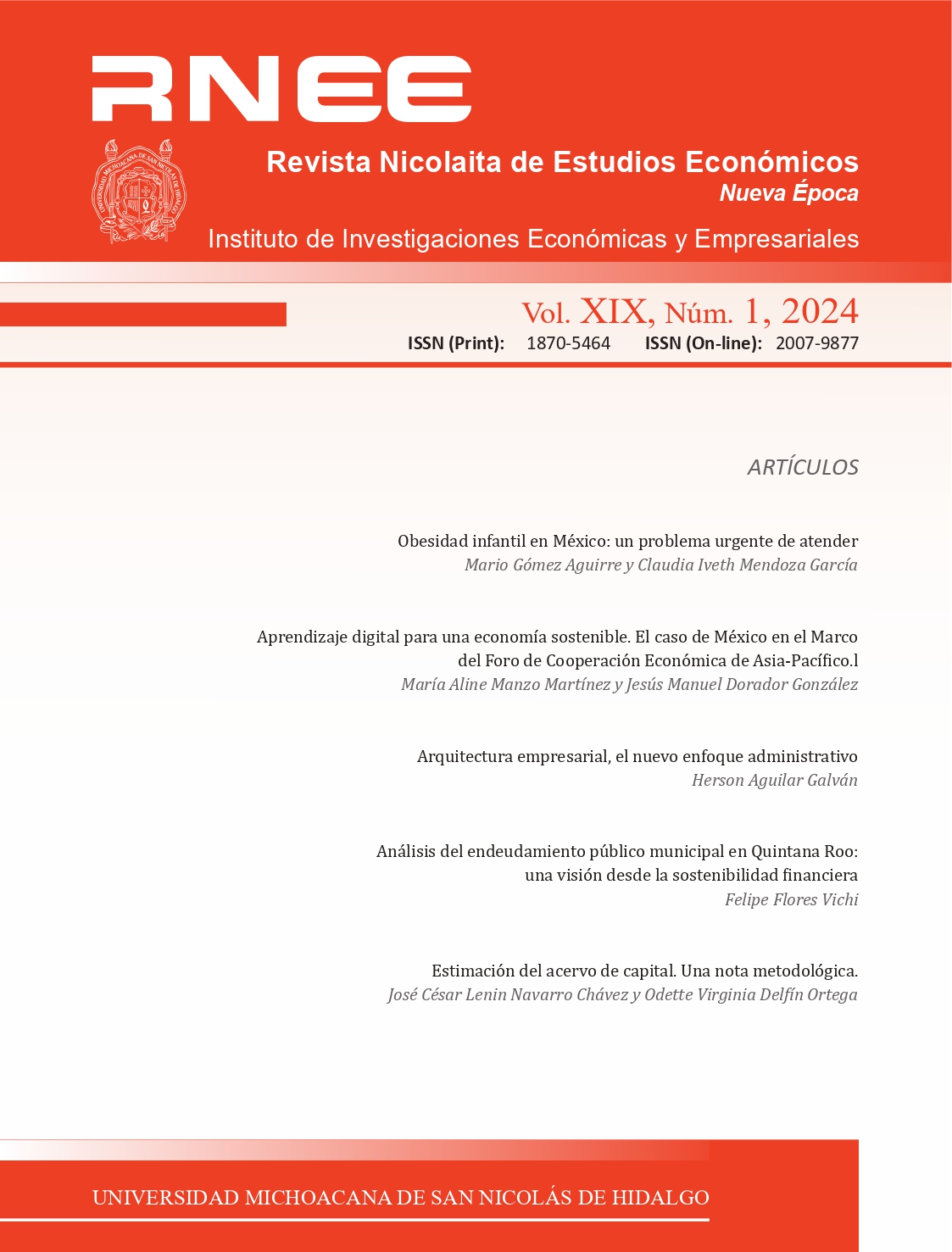
Analysis of the marketing mix in Mexico and renewable energiesas part of its economic growth in APEC for the period 2015-2024
DOI:
https://doi.org/10.33110/rnee.v19i1.355Keywords:
APEC, climate change, economic growth, marketing, renewable energyAbstract
The objective of this study is to determine if the adoption of e-commerce by small local rms in the Sierra de los
Agustinos subregion, Guanajuato, Mexico, might contribute to unemployment reduction and, consequently, to
reduce migratory intensity. The subregion has been characterized, to this day, by its high migratory intensity and
signicant presence of tertiary activities. The analysis was carried out through a eld study, with a sample of 258
observation units, and the specication of an econometric model, based on the sample generated information.
Results indicate that unemployment, income, insecurity, pre-existing migratory conditions, the number of family
members and e-commerce determine migration in the study region.
Downloads
References
Agencia Internacional de Energía Renovable (IRENA). (2023). Renewable Capacity Statistics 2020. IRENA.
Banco Mundial. (2024). Datos de libre acceso. https://datos.bancomundial.org/ Catalán, H. (2014). Curva ambiental del Kuznets: implicaciones para un crecimiento sustentable. Economía informa, 389, 19-37. https://doi.org/10.1016/S0185-0849(14)72172-3.
European Commission Directorate General for Energy and Transport (DG-TREN) (2017), Key World Energy Statistics, Brussels: European Commission
European Union, (2023), Sustainable development in the European Union, Luxembourg: Publications Ofce of the European Union
Foro de Cooperación Económica Asia Pacíco (APEC). (2023). Recuperado el 6 de abril de 2023.
Falconi, F., Burbano, R. & Cango, P. (2016). La discutible curva de Kuznets. Documento de trabajo. FLACSO Ecuador.
Gómez, M. (2023). Comercio, crecimiento económico y contaminación ambiental: Un análisis de datos panel en las economías de APEC (1995-2018). Economía y sociedad en APEC: Transiciones poscovid 2019. Universidad de Colima.
Hored R. (2017). Estudios económicos de la OCDE: México 2017. Secretaria de Energía, Ciudad de México.
López A., García A. (2005). Las energías alternativas. Revista de Occidente, 286, 89-97.
Monteiro, T. A., Giuliani, A. C., Cavazos-Arroyo, J., y Kassouf Pizzinatto, N. (2015). Mezcla del marketing verde: una perspectiva teórica. Cuadernos del CIMBAGE, (17), 103-126. http://www.redalyc.org/articulo.oa?id=46243484005
Olivares, J. & Hernández, C. (2021). ¿La curva ambiental de Kuznets sigue siendo válida para explicar la degradación? Una revisión teórica. Economía Coyuntural, 6(3), 3-52.
Organización de las Naciones Unidas (ONU). (2015). Objetivos de Desarrollo Sostenible. Recuperado el 22 de julio de 2023. En: https://www.undp.org/es/sustainable-development-goals
Comisión Nacional de Hidrocarburos. (2023). URL: https://www.gob.mx/cnh
Paul B. (2007). Future energy: how the new oil industry will change people, politics, and portfolios. New Jork. John Wiley & Sons Report of the world situation, (2016), Renewable energy, Paris: REN21.
Secretaría de Economía (SE 2015). ¿Qué es la APEC? https://www.gob.mx/se/articulos/que-es-apec
Secretaría de Energía (SENER). (2023). Prospectiva del Sector Eléctrico 2019-2033. Gobierno de México. https://www.gob.mx/sener/documentos/prospectiva-del-sector-electrico-2019-2033
Downloads
Published
How to Cite
Issue
Section
License

This work is licensed under a Creative Commons Attribution-NonCommercial-NoDerivatives 4.0 International License.