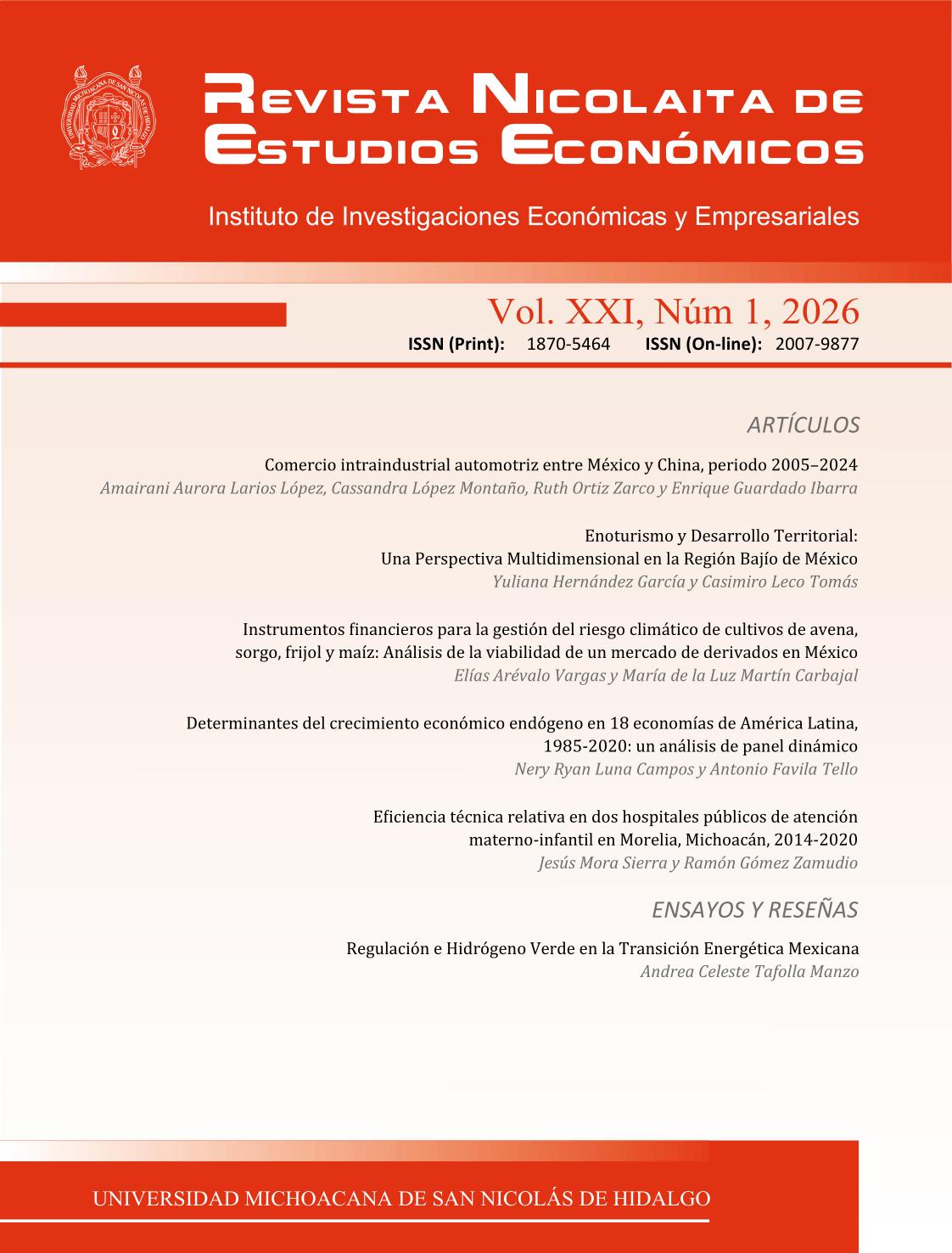
Regulation and Green Hydrogen in Mexico’s Energy Transition
DOI:
https://doi.org/10.33110/rnee.v21i1.386Keywords:
economic growth, energy transition, green hydrogen, regulatory efficiency, renewable energyAbstract
This essay analyzes Mexico’s energy transition through the interaction between regulatory efficiency, economic growth, foreign trade, renewable energy and green hydrogen. Based on a documentary review and analytical synthesis of academic and technical literature, it argues that CO₂ mitigation depends not only on additional renewable capacity, but also on stable rules, grid infrastructure, finance, institutional coordination and social legitimacy. The essay concludes that green hydrogen can extend decarbonization to hard-to-electrify sectors, provided that it is integrated into a coherent, transparent and socially just energy policy framework.
Downloads
References
Acemoglu, D. y Robinson, J. (2019). The Narrow Corridor: States, Societies, and the Fate of Liberty.
Penguin Books. Acquah, E., Carbonari, L., Farcomeni, A. y Trovato, G. (2023). Institutions and economic development: new measurements and evidence. Empirical Economics, 65, 1693-1728. https://doi.org/10.1007/s00181-023-02395-w
Baker, L., Cao, U., Chipango, E., Fathoni, H., Munro, P. y Samarakoon, S. (2025). Of Energy Transitions and the State. The Case of Mexico’s Attempted Electricity Reform. En L. Baker, U. Cao, E. Chipango, H. Fathoni, P. Munro y S. Samarakoon (Eds.), Electricity Capital and Energy Poverty.
Perspectives From Developmental States and Decentralised Markets (pp. 89-107). Palgrave Macmillan. https://doi.org/10.1007/978-3-031-94358-4_5
Becerra-López, H., De Silva, L., Flores, J., Lira, R. y Romero, T. (2025). Forecasting regional green hydrogen demand in Mexico by 2035. International Journal of Hydrogen Energy, 141(25), 1039-1049. https://doi.org/10.1016/j.ijhydene.2025.01.132
Brändle, G., Schönfisch, M. y Schulte, S. (2021). Estimating long-term global supply costs for low-carbon hydrogen. Applied Energy, 302, 117481. https://doi.org/10.1016/j.apenergy.2021.117481
Chen, C., Pinar, M. y Stengos, T. (2022). Renewable energy and CO₂ emissions: New evidence with the panel threshold model. Renewable Energy, 194, 117-128. https://doi.org/10.1016/j.renene.2022.05.095
Delgado, J., Saldaña, M. y Mellardo, C. (2024). Eficiencia energética en los municipios de México. International Journal of Professional Business Review, 9(9), 2-18. https://doi.org/10.26668/businessreview/2024.v9i9.4819
Denholm, P., Novacheck, J., Jorgenson, J. y O’Connell, M. (2016). Impact of Flexibility Options on Grid Economic Carrying Capacity of Solar and Wind: Three Case Studies. National Renewable Energy Laboratory. https://docs.nrel.gov/docs/fy17osti/66854.pdf
Elizondo, A. (2022). Bringing Emissions Trading Schemes into Mexican Climate Policy. En S. Lucatello (Ed.), Towards an Emissions Trading System in Mexico: Rationale, Design and Connections with the Global Climate Agenda (pp. 33-47). Springer. https://doi.org/10.1007/978-3-030-82759-5_2
Escamilla-García, P., Rivera-González, G., Rivera, A. y Soto, F. (2024). Socio-Economic Determinants of Greenhouse Gas Emissions in Mexico: An Analytical Exploration over Three Decades. Sustainability, 16(17), 7668. https://doi.org/10.3390/su16177668
Esparza, J. y Hernández, C. (2023). ¿Se retroalimentan las energías renovables con el crecimiento económico en México?: Análisis del 2013-2020. Paradigma Económico, 15(2), 143-173. https://doi.org/10.36677/paradigmaeconomico.v15i2.21930
García-Garza, M., Ortiz-Rodríguez, J., Picazzo-Palencia, E., Munguía, N. y Velazquez, L. (2023). The 2013 Mexican Energy Reform in the Context of Sustainable Development Goal 7. Energies, 16(19), 6920. https://doi.org/10.3390/en16196920
Giannini, S., Reniers, G., Yang, M., Nogal, M. y Paltrinieri, N. (2025). Cost-Informed Risk-Based Inspection (CIRBI) for hydrogen systems. Reliability Engineering & System Safety, 260, 111063. https://doi.org/10.1016/j.ress.2025.111063
Glenk, G. y Reichelstein, S. (2019). Economics of converting renewable power to hydrogen. Nature Energy, 4(2), 216-222. https://doi.org/10.1038/s41560-019-0326-1
Grossman, G. y Krueger, A. (1995). Economic growth and the environment. The Quarterly Journal of Economics, 110(2), 353-377. https://doi.org/10.2307/2118443
Hagemann, M., Nilsson, A. y Röser, F. (2024). Understanding finance needs for a just transition of the Mexican power sector. NewClimate Institute. https://newclimate.org/resources/publications/understanding-finance-needs-for-a-just-transition-of-the-mexican-power
Hernández, G., Tapia, L., Toledo, A. y Guzmán, D. (2022). La transición energética bajo prácticas autoritarias. Tres casos en México. Desafíos, 34(2), 1-40. https://doi.org/10.12804/revistas.urosario.edu.co/desafios/a.11474 International Renewable Energy
Agency (IRENA). (2020). Green hydrogen cost reduction: Scaling up electrolysers to meet the 1.5°C climate goal. IRENA. https://www.irena.org/-/media/Files/IRENA/Agency/Publication/2020/Dec/IRENA_Green_hydrogen_cost_2020.pdf
Jenkins, J. y Karplus, V. (2016). Carbon pricing under binding political constraints. WIDER Working Paper Series, 2016/44. https://www.wider.unu.edu/sites/default/files/wp2016-44.pdf
Kittner, N., Lill, F. y Kammen, D. (2017). Energy storage deployment and innovation for the clean energy transition. Nature Energy, 2(9), 17125. https://doi.org/10.1038/nenergy.2017.125
Makepeace, R., Tabandeh, A., Hossain, M. y Asaduz-Zaman, M. (2024). Techno-economic analysis of green hydrogen export. International Journal of Hydrogen Energy, 56(2), 1183-1192. https://doi.org/10.1016/j. ijhydene.2023.12.212
Meng, B., Peters, G., Wang, Z. y Li, M. (2018). Tracing CO₂ emissions in global value chains. Energy Economics, 73, 24-42. https://doi.org/10.1016/j.eneco.2018.05.013
Nikas, A., Gambhir, A., Trutnevyte, E., Koasidis, K., Lund, H., Thellufsen, J. y Mayer, D. (2021). Perspective of comprehensive and comprehensible multi-model energy and climate science in Europe. Energy, 215, 119153. https://doi.org/10.1016/j.energy.2020.119153
Palacios, A., Martins, R., Palacios-Rosas, E., Castro-Olivera, P. M., Oros, A., Lizcano, F., Poblano, D., Enciso, A. y Bonilla, H. (2025). Hydrogen in Mexico: A technical and economic feasibility perspective for the transition to a hydrogen economy. International Journal of Hydrogen Energy, 108(12), 99-112. https://doi.org/10.1016/j.ijhydene.2024.03.116
Palacios, R., Masera, O., Ferrari, L. y Canales, D. (2024). Futuros energéticos para México al 2050:
El camino para una transición energética justa y sustentable. Pronace ECC-Conahcyt. Pan, C., Peters, G., Andrew, R., Korsbakken, J., Li, S., Zhou, D. y Zhou, P. (2017). Emissions embodied in global trade have plateaued due to structural changes in China. Earth’s Future, 5(8), 934-946. https://doi.org/10.1002/2017EF000625
Probst, O. (2024). Clean Energy and Carbon Emissions in Mexico’s Electric Power Sector: Past Performance and Current Trend. Energies, 17(23), 5859. https://doi.org/10.3390/en17235859
Ramírez, J., Ortiz-Arango, F. y Rosellón, J. (2021). Impact of Mexico’s energy reform on consumer welfare. Utilities Policy, 70, 101191. https://doi.org/10.1016/j.jup.2021.101191
Rosas, J., Morillón, D. y Silva, R. (2024). Effects of removing energy subsidies and implementing carbon taxes on urban, rural and gender welfare: evidence from Mexico. Energies, 17(9), 2237. https://doi. org/10.3390/en17092237
Shahnazi, R. y Dehghan Shabani, Z. (2021). The effects of renewable energy, spatial spillover of CO₂ emissions and economic freedom on CO₂ emissions in the EU. Renewable Energy, 169, 293-307. https://doi. org/10.1016/j.renene.2021.01.016
Sovacool, B. (2016). How long will it take? Conceptualizing the temporal dynamics of energy transitions. Energy Research & Social Science, 13, 202-215. https://doi.org/10.1016/j.erss.2015.12.020
Staffell, I., Scamman, D., Velázquez, A., Balcombe, P., Dodds, P., Ekins, P. y Shah, N. (2019). The role of hydrogen and fuel cells in the global energy system. Energy & Environmental Science, 12(2), 463-491. https://doi.org/10.1039/C8EE01157E
Steinhauser, D., Kittová, Z. y Khúlová, L. (2024). Relationship Between CO₂ Emissions and Trade: The Case of the EU. Intereconomics, 59(1), 41-47. https://doi.org/10.2478/ie-2024-0009
Tacuba, A. (2022). Pemex: oil price and financial management in the context of elevated fiscal burden. Journal of Economics, Finance and Administrative Science, 27(53), 175-194. https://doi.org/10.1108/JEFAS-06-2021-0094
Ueckerdt, F., Verpoort, P., Anantharaman, R., Bauer, C., Beck, F., Longden, T. y Roussanaly, S. (2024). On the cost competitiveness of blue and green hydrogen. Joule, 8(1), 104-128. https://doi.org/10.1016/j. joule.2023.12.004
Varela, A. y Carbajal, C. (2022). ¿Realmente fue positivo el saldo de la privatización de la Reforma Energética en México? Revista Mexicana de Economía y Finanzas, 17(3), 1-16.
Vera, M., De la Vega, A. y Samperio, J. I. (2021). Climate change and income inequality: An IO analysis of the structure and intensity of the GHG emissions in Mexican households. Energy for Sustainable Development, 60, 15-25. https://doi.org/10.1016/j.esd.2020.11.002
Vidal, J., Baena, R. y Therán, K. (2024). Implementation and feasibility of green hydrogen in Colombian kitchens: An analysis of innovation and sustainability. Indonesian Journal of Electrical Engineering and Computer Science, 34(2), 726-744. https://doi.org/10.11591/ijeecs.v34.i2.pp726-744
Zárate, E. (2023). Sociología de energías renovables y transformación energética en México. Estudios Sociológicos, 41(122), 441-470. http://dx.doi.org/10.24201/es.2023v41n122.2271
Zhao, X., Yang, X., Peng, G. y Yue, S. (2023). International Trade and Carbon Emissions: Evaluating the Role of Trade Rule Uncertainty. Sustainab
Downloads
Published
How to Cite
Issue
Section
License

This work is licensed under a Creative Commons Attribution-NonCommercial-NoDerivatives 4.0 International License.