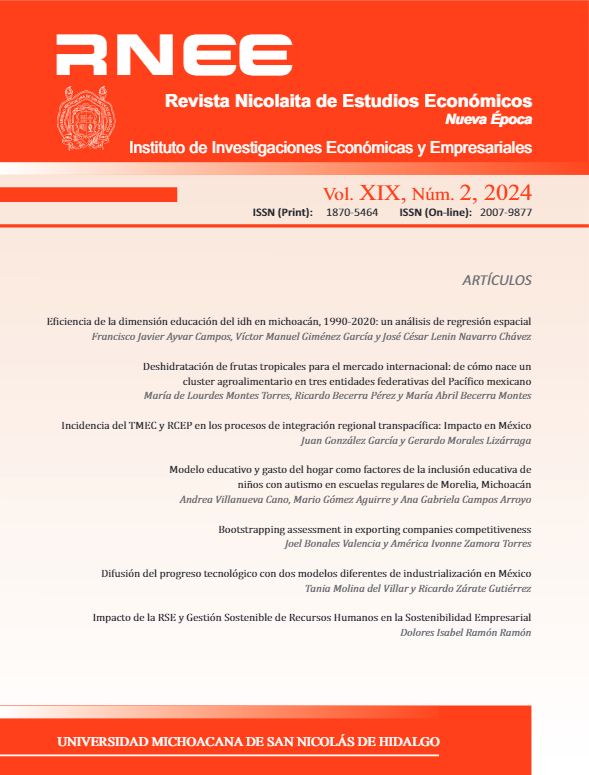
Evaluación del bootstrapping en la competitividad de las empresas exportadoras
DOI:
https://doi.org/10.33110/rnee.v19i2.361Palabras clave:
Competitividad, Empresas exportadoras, Mínimos cuadrados parciales, método de remuestreoResumen
This investigation article presents the result of a scientic research carried out to the Exporting Companies of the
Agricultural Sector in the state of Michoacan. Its general objective is to determine the interrelationships between
the critical variables that dene the International Competitiveness of companies that export agricultural
products to the United States market, located in the state of Michoacan. A theoretical review was made, which
identied the variables -quality, price, training, indices, and indicators that were integrated into a questionnaire
composed of 38 items and applied to the identied exporting companies in the sector. Once the information was
processed, different statistical techniques were used, and with the results obtained a Structural Model was
identied that describes how these variables are interrelated, based on the Partial Least Square Modeling
Statistical Technique (PLS) and the Bootstrapping model. After applying the questionnaire to agricultural
exporting companies, the processing of the data of each of the surveyed companies was continued, through
parametric statistics and the application of variance correlation.
Citas
Barroso, C., Cepeda, G., & Roldán, J. L. (2005). Investigar en Economía de la Empresa ¿Partial Least Squares o modelos basados en la covarianza?
In Best Papers Proceedings. Bassioni, H. A., Price, A. D. F., & Hassan, T. M. (2005). Building a conceptual framework for measuring business performance in construction: an empirical evaluation. Construction Management and Economics, 23(5), 495–507.
Batista Foguet, J. M., & Coenders Gallart, G. (2000). Modelos de ecuaciones estructurales: modelos para el análisis de relaciones causales.
Bonales, J., Ochoa, J., & Cortéz, A. (2013). Modelo Competitivo de Variables Jerárquicas de Empresas Exportadoras. Mercados Y Negocios (1665-7039), 0(28), 53–70. Retrieved from http://revistascienticas.udg.mx/index.php/MYN/article/view/5245
Chernick, M. R., González-Manteiga, W., Crujeiras, R. M., & Barrios, E. B. (2011). Bootstrap methods. Springer. Chin, J. Henseler, & H. Wang (Eds.), Handbook of Partial Least Squares: Concepts, Methods and Applications (pp. 655–690). Berlin, Heidelberg: Springer Berlin Heidelberg. https://doi.org/10.1007/978-3-540-32827-8_29
Delgado, M., Ketels, C., Porter, M. E., & Stern, S. (2012).
The determinants of national competitiveness. National Bureau of Economic Research. Dosi, G. (1988). Sources, procedures, and microeconomic effects of innovation. Journal of Economic Literature, 1120–1171.
Duarte, P. A. O., & Raposo, M. L. B. (2010). A PLS model to study brand preference: An application to the mobile phone market. In Handbook of partial least squares (pp. 449–485).
Springer. Haenlein, M., & Kaplan, A. M. (2004). A beginner's guide to partial least squares analysis. Understanding Statistics, 3(4), 283–297.
Hair Jr, J. F., Hult, G. T. M., Ringle, C., & Sarstedt, M. (2016). A primer on partial least squares structural equation modeling (PLS-SEM).
Sage Publications. Horta, R., & Jung, A. (2002). Competitividad e industria manufacturera. Aportes para un marco de análisis. Revista Electrónica de La Facultad de Ciencias Económicas de La Universidad Católica, 1(1), 1–38.
Lévy, J.-P., & Varela, J. (2003).
Análisis multivariable para las ciencias sociales. Madrid, Editorial Pearson Educación. Loehlin, J. C. (1998). Latent variable models: An introduction to factor, path, and structural analysis.
Lawrence Erlbaum Associates Publishers. Mac Kinnon, D. P., Lockwood, C. M., & Williams, J. (2004). Condence limits for the indirect effect: Distribution of the product and resampling methods. Multivariate Behavioral Research, 39(1), 99–128.
Nitzl, C., Roldan, J. L., & Cepeda, G. (2016). Mediation analysis in partial least squares path modeling: Helping researchers discuss more sophisticated models. Industrial Management & Data Systems, 116(9), 1849–1864. https://doi.org/10.1108/IMDS-07-2015-0302
Porter, M. E. (2011). Competitive advantage of nations: creating and sustaining superior performance.
Simon and Schuster. Roldán, J. L., & Sánchez-Franco, M. J. (2012). Variance-based structural equation modeling: guidelines for using partial least squares. Information Systems Research, in Research Methodologies, Innovations and Philosophies in Software Systems Engineering and Information Systems, 193–221.
Schumacker, R. E., & Lomax, R. G. (2004).
A beginner's guide to structural equation modeling. Psychology Press. Virla, M. Q. (2010). Conabilidad y coeciente Alpha de Cronbach. Telos, 12(2), 248–252.
Wood, M. (2005). Bootstrapped condence intervals as an approach to statistical inference. Organizational Research Methods, 8(4), 454–470.
Descargas
Publicado
Cómo citar
Número
Sección
Licencia

Esta obra está bajo una licencia internacional Creative Commons Atribución-NoComercial-SinDerivadas 4.0.