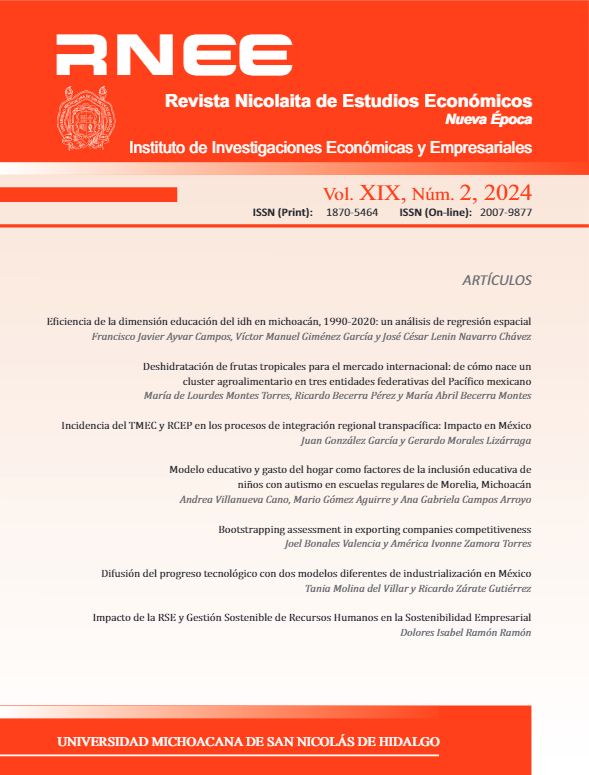
Impact of CSR and Sustainable Human Resources Management on Business Sustainability
DOI:
https://doi.org/10.33110/rnee.v19i2.363Keywords:
Corporate Social Responsibility, Sustainable Human Resources Management, Business Sustainability, Human Resource Wellbeing, Human Resource SatisfactionAbstract
Corporate Social Responsibility and Human Resources Management are currently applied with a strategic
approach to meet the demands of various stakeholders, with Human Resources being the primary, direct, key and
urgently needed interest group by companies operating in the international market, as they are the ones through
whom strategic objectives, productivity, expansion into new markets, and construction of credibility and
reputation are achieved. This research aims to examine the Corporate Social Responsibility factors that have the
greatest impact on human resources working in medium and large companies engaged in foreign trade. The
methodology used is quantitative and descriptive, using non-probabilistic sampling, surveying 302 employees
working in this type of companies, and applying a questionnaire validated by several authors. The results show
that human resources value Corporate Social Responsibility practices that guarantee equal opportunities,
diversity and inclusion, ethical behavior of the leader, satisfaction and well-being of human resources, factors that
constitute a fundamental basis for the company to develop sustainability and business competitiveness. However,
companies in this sector have not fully met these expectations.
Downloads
References
An, Y. (2021). Corporate social responsibility and overseas income. Finance Research Letters, 39, 101594.
Ambrose, M. L., Arnaud, A., & Schminke, M. (2008). Individual moral development and ethical climate: The inuence of person–organization t on job attitudes. Journal of Business Ethics, 77, 323–333.
Arzabe, F. A. (2021). Mejora organizacional enfocando la responsabilidad social empresarial, basada en el recurso humano de las organizaciones. Revista Latinoamericana de Ciencias Económicas y Sociales (RLCES), 6(2), 126-151.
Arredondo-Hidalgo, M. G., & Caldera González, D. D. C. (2021). Analysis of CSR and the impact of the supply chain on sustainable performance practices: a case study of a mexican exporting company. Investigación & Desarrollo, 29(1), 15-40.
Banerjee, S., Homroy, S., & Slechten, A. (2022). Stakeholder preference and strategic corporate social responsibility. Journal of Corporate Finance, 77, 102286.
Bass, B. M., & Avolio, B. J. (1996).
Multifactor leadership questionnaire. Western Journal of Nursing Research. Bashir, M. (2024). Corporate social responsibility and nancial performance–the role of corporate reputation, advertising and competition. PSU Research Review, 8(2), 389-402.
Boselie, P., Dietz, G., & Boon, C. (2005). Commonalities and contradictions in HRM and performance research. Human resource management journal, 15(3), 67-94.
Chen, X., Huang, R., Yang, Z., & Dube, L. (2018). CSR types and the moderating role of corporate competence. European Journal of Marketing, 52(7/8), 1358-1386. https://doi.org/https://doi.org/10.1108/EJM-12-2016-0702
Cheema, S., Afsar, B., & Javed, F. (2020). Employees' corporate social responsibility perceptions and organizational citizenship behaviors for the environment: The mediating roles of organizational identication and environmental orientation t. Corporate Social Responsibility and Environmental Management, 27(1), 9–21. COMISIÓN DE LAS COMUNIDADES EUROPEAS (2001): Libro Verde. Fomentar un Marco Europeo para la Responsabilidad Social de las Empresas. Documento COM (2001) 366 nal. Luxemburgo: Ocina de
Publicaciones de las Comunidades Europeas. Del-Castillo-Feito, C., Blanco-González, A., & Hernández-Perlines, F. (2022). The impacts of socially responsible human resources management on organizational legitimacy. Technological Forecasting and Social Change, 174, 121274.
Harrison, V. S., Vafeiadis, M., Diddi, P., Buckley, C., & Dardis, F. E. (2022). Understanding how corporate social responsibility partnership factors inuence nonprot supportive intentions. Public Relations Review, 5(102-184), 48. https://doi.org/https://doi.org/10.1016/j.pubrev.2022.102184
Herkenhoff, P., Krautheim, S., Semrau, F. O., & Steglich, F. (2024). Corporate Social Responsibility along the global value chain. Journal of Development Economics, 167, 103236.
Lee, S. Y., Kim, Y., & Kim, Y. (2021). Engaging consumers with corporate social responsibility campaigns: The roles of interactivity, psychological empowerment, and identication. Journal of Business Research, 134, 507-517. https://doi.org/https://doi.org/10.1016/j.jbusres.2021.05.062
Lewis, R. E., & Heckman, R. J. (2006). Talent management: A critical review. Human resource management review, 16(2), 139-154. https://doi.org/https://doi.org/10.1016/j.hrmr.2006.03.001
Li, Z., Wei, S. Y., Chunyan, L., Aldoseri, M. M. N., Qadus, A., & Hishan, S. S. (2022). The impact of CSR and green investment on stock return of Chinese export industry. Economic research-Ekonomska istraživanja, 35(1), 4971-4987.
Lindgreen, A., & Swaen, V. (2010). Corporate social responsibility. International journal of management reviews, 12(1), 1-7. https://doi.org/https://doi.org/10.1111/j.1468-2370.2009.00277.x
Lu, H., Oh, W. Y., Kleffner, A., & Chang, Y. K. (2021). How do investors value corporate social responsibility? Market valuation and the rm specic contexts. Journal of Business Research, 125, 14-25.
Luna-Arocas, R., & Danvila-del-Valle, I. (2022). The impact of talent management on ethical behavior and intention to stay in the organization. Journal of Management & Organization, 1-16. https://doi.org/https://doi.org/10.1017/jmo.2022.64
Martínez-Sala, A.-M., Monserrat-Gauchi, J., & Quiles-Soler, C. (2023). Corporate social responsibility and millennial consumer loyalty: exploring their relationship regarding healthy eating in the fast food sector. Profesional De La información, 32(6). https://doi.org/https://doi.org/10.3145/epi.2023.nov.13
Mariappanadar, S., & Kramar, R. (2014). Sustainable HRM: The synthesis effect of high-performance work systems on organisational performance and employee harm. Asia-Pacic Journal of Business Administration, 6(3), 206-224.
Muster, V., & Schrader, U. (2011). Green work-life balance: A new perspective for green HRM. German Journal of Human Resource Management, 25(2), 140-156.
Na-Nan, K., Kanthong, S., & Joungtrakul, J. (2021). An empirical study on the model of self-efcacy and organizational citizenship behavior transmitted through employee engagement, organizational commitment and job satisfaction in the thai automobile parts manufacturing industry. Journal of Open Innovation: Technology, Market, and Complexity, 7(3), 170.
Nguyen, N. T. T., Nguyen, N. P., & Hoai, T. T. (2021). Ethical leadership, corporate social responsibility, rm reputation, and rm performance: A serial mediation model. Heliyon, 7(4). https://www.un.org/sustainabledevelopment/es/objetivos-de-desarrollo-sostenible/
Ortiz-Martínez, E., Marín-Hernández, S., & Santos-Jaén, J. M. (2023). Sustainability, corporate social responsibility, non-nancial reporting and company performance: Relationships and mediating effects in Spanish small and medium sized enterprises. Sustainable Production and Consumption, 35, 349-364.
Peloza, J., & Shang, J. (2011). How can corporate social responsibility activities create value for stakeholders? A systematic review. Journal of the Academy of Marketing Science, 39, 117–135. https://doi.org/https://doi.org/10.1007/s11747-010-0213-6
Sabokro, M., Masud, M. M., & Kayedian, A. (2021). The effect of green human resources management on corporate social responsibility, green psychological climate and employees' green behavior. Journal of Cleaner Production, 313, 127963.
Saks, A. M. (2022). Caring human resources management and employee engagement. Human resource management review, 32(3), 100835. Salas-Vallina, A., Pasamar, S. and Donate, M.J. (2021), “Well-being in times of illbeing: how AMO HRM practices improve organizational citizenship behaviour through work-related well-being and service leadership”, Employee Relations: The International Journal, Emerald Publishing Limited, Vol. 43 No. 4, pp. 911–935, doi: 10.1108/ER-05-2020-0236.
Shahzad, F., Baig, M. H., Rehman, I. U., Saeed, A., & Asim, G. A. (2022). Does intellectual capital efciency explain corporate social responsibility engagement-rm performance relationship? Evidence from environmental, social and governance performance of US listed rms. Borsa Istanbul Review, 22(2), 295-305.
Sarwar, H., Ishaq, M. I., Amin, A., & Ahmed, R. (2020). Ethical leadership, work engagement, employees' well- being, and performance: a cross-cultural comparison. Journal of Sustainable Tourism, 28(12), 2008–2026.
Singh, K., & Misra, M. (2021). Linking corporate social responsibility (CSR) and organizational performance: The moderating effect of corporate reputation. European Research on Management and Business Economics, 27(1), 100139. Tomás de
Cavia, F. T. (2024). El Valor de la Responsabilidad Social Corporativa en los Procesos de Inversión Internacional. Aproximación Teórica a un Intangible. Investigación Y Pensamiento Crítico, 12(1), 29–40. https://doi.org/10.37387/ipc.v12i1.372 Taušová, M., Tauš, P. and Domaracká, L. (2022), “Sustainable Development According to Resource Productivity in the EU Environmental Policy Context”, Energies 2022, Vol. 15, Page 4291, Multidisciplinary Digital Publishing Institute, Vol. 15 No. 12, p. 4291, doi: 10.3390/EN15124291.
Úbeda-García, M., Claver-Cortés, E., Marco-Lajara, B., & Zaragoza-Sáez, P. (2021). Corporate social responsibility and rm performance in the hotel industry. The mediating role of green human resource management and environmental outcomes. Journal of Business Research, 123, 57-69.
Vizcaíno, F. V., Martin, S. L., Cardenas, J. J., & Cardenas, M. (2021). Employees' attitudes toward corporate social responsibility programs: The inuence of corporate frugality and polychronicity organizational capabilities. Journal of Business Research, 124, 538-546. Yousean, M.,
Bascompta, M., Sanmiquel, L., & Vintró, C. (2023). Corporate social responsibility and economic growth in the mining industry. The Extractive Industries and Society, 13, 101226.
Zhang, Q., & Ahmad, S. (2021). Analysis of Corporate Social Responsibility Execution Effects on Purchase Intention with the Moderating Role of Customer Awareness. Sustainability, 13(8), 45-48. https://doi.org/https://doi.org/10.3390/su13084548
Zhao, H., & Zhou, Q. (2021). Socially responsible human resource management and hotel employee organizational citizenship behavior for the environment: A social cognitive perspective. International Journal of Hospitality Management, 95, 102749.
Downloads
Published
How to Cite
Issue
Section
License

This work is licensed under a Creative Commons Attribution-NonCommercial-NoDerivatives 4.0 International License.