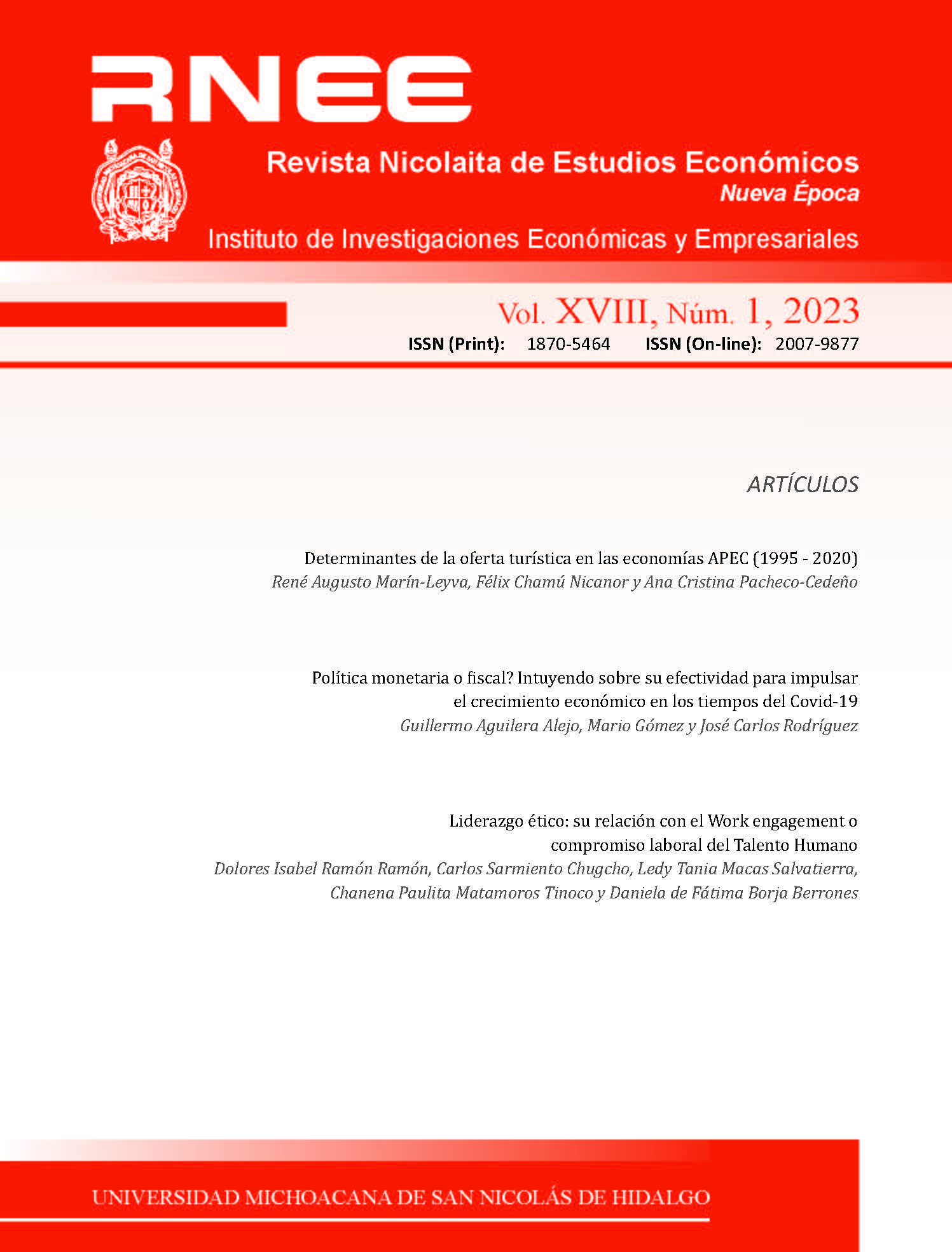
Ethical leadership: its relationship with the work engagement or commitment of human talent
DOI:
https://doi.org/10.33110/rnee.v18i1.345Keywords:
Ethical leadership, Work engagement, Work commitment, Human talent, University of MachalaAbstract
Ethical leadership positively influences the work engagement of administrative staff, counteracting psychosocial risks and improving institutional competitiveness through managerial integrity. This study, validated at the Technical University of Machala, demonstrates that transparency and ethical values foster a climate of high trust, increasing talent retention and ensuring organizational strategic success.
Downloads
References
Adnan, N., Bhatti, O. K., & Farooq, W. (2020). Relating ethical leadership with work engagement: How workplace spirituality mediates? Cogent Business & Management, 7(1), 1739494
Ahmad, I., & Gao, Y. (2018). Ethical leadership and work engagement: The roles of psychological empowerment and power distance orientation. Management Decision, 56(9), 1991–2005.
Bachmann, B. (2017). Literature review: The evolution of ethical leadership. Ethical Leadership in Organizations: Concepts and Implementation, 27–63.
Bakker, A. B., Schaufeli, W. B., Leiter, M. P., & Taris, T. W. (2008). Work engagement: An emerging concept in occupational health psychology. Work & stress, 22(3), 187–200.
Bird, J. J., Wang, C., Watson, J. R., & Murray, L. (2009). Relationships among Principal Authentic Leadership and Teacher Trust and Engagement Levels. Journal of School Leadership, 19(2), 153–171. https://doi.org/10.1177/105268460901900202
Blok, V., Wesselink, R., Studynka, O., & Kemp, R. (2015). Encouraging sustainability in the workplace: A survey on the pro-environmental behaviour of university employees. Journal of cleaner production, 106, 55–67.
Brown, M. E., Treviño, L. K., & Harrison, D. A. (2005). Ethical leadership: A social learning perspective for construct development and testing. Organizational Behavior and Human Decision Processes, 97(2), 117–134. https://doi.org/https://doi.org/10.1016/j.obhdp.2005.03.002
Brown, M. E., & Treviño, L. K. (2006). Ethical leadership: A review and future directions. The Leadership Quarterly, 17(6), 595–616. https://doi.org/https://doi.org/10.1016/j.leaqua.2006.10.004
Deery, S., Walsh, J., & Zatzick, C. D. (2014). A moderated mediation analysis of job demands, presenteeism, and absenteeism. Journal of occupational and organizational psychology, 87(2), 352–369.
Demerouti, E., Xanthopoulou, D., Petrou, P., & Karagkounis, C. (2017). Does job crafting assist dealing with organizational changes due to austerity measures? Two studies among Greek employees. European Journal of Work and Organizational Psychology, 26(4), 574–589.
Gallup. (2019). Building a High-Development
Culture Through Your Employee Engagement Strategy. Gallup Inc. Gallup, A. C. (2021). On the link between emotional contagion and contagious yawning. Neuroscience & Biobehavioral Reviews, 121, 18–19.
George, D., & Mallery, P. (2019). IBM SPSS statistics 26 step by step: A simple guide and reference. Routledge. Gruman y Saks, (2011); Macey y Schneider, (2008
Gu, Q., Tang, T. L.-P., & Jiang, W. (2015). Does moral leadership enhance employee creativity? Employee identication with leader and leader–member exchange (LMX) in the Chinese context. Journal of business ethics, 126, 513–529.
Harter, S. (2002).
Authenticity. Khumalo, N., Dumont, K. B., & Waldzus, S. (2022). Leaders' inuence on collective action: An identity leadership perspective. The Leadership Quarterly, 33(4), 101609.
Macey, W. H., & Schneider, B. (2008). The Meaning of Employee Engagement. Industrial and Organizational Psychology, 1(1), 3–30. https://doi.org/DOI: 10.1111/j.1754-9434.2007.0002.x
Schaufeli, W. B., Salanova, M., González-romá, V., & Bakker, A. B. (2002). The Measurement of Engagement and Burnout: A Two Sample Conrmatory Factor Analytic Approach. Journal of Happiness Studies, 3(1), 71–92. https://doi.org/10.1023/A:1015630930326
Treviño, L. K., Hartman, L. P., & Brown, M. (2000). Moral Person and Moral Manager: How Executives Develop a Reputation for Ethical Leadership. California Management Review, 42(4), 128–142. https://doi.org/10.2307/41166057
Unda, S., Uribe, F., Jurado, S., García, M., Tovalín, H., & Juárez, A. (2016). Elaboración de una escala para valorar los factores de riesgo psicosocial en el trabajo de profesores universitarios. Revista de Psicología del Trabajo y de las Organizaciones, 32(2), 67–74.
Downloads
Published
How to Cite
Issue
Section
License

This work is licensed under a Creative Commons Attribution-NonCommercial-NoDerivatives 4.0 International License.