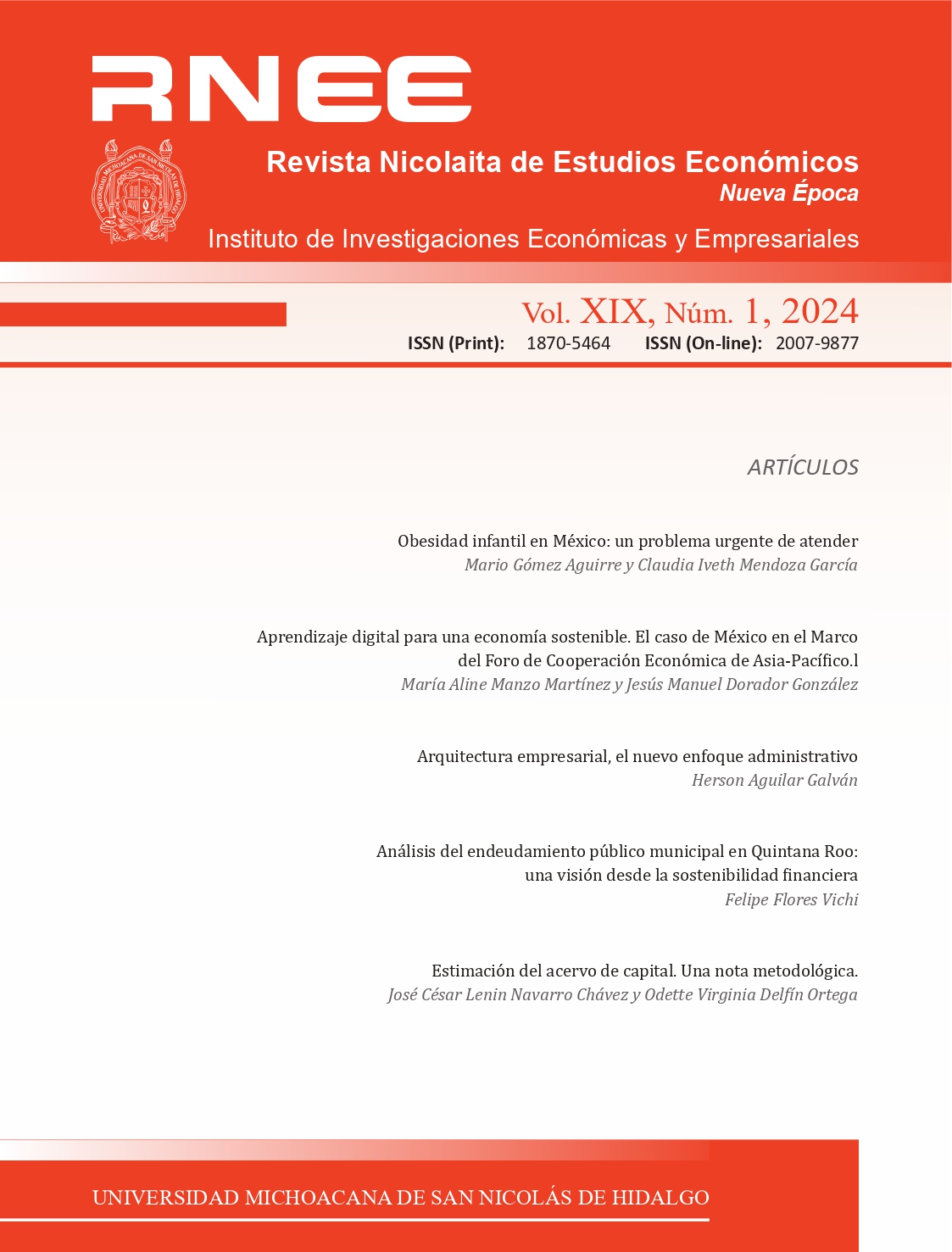
The Capital Stock in the Manufacturing Industry of North American Countries: An Estimate Based on the Perpetual Inventory Method with an Adjustment Factor
DOI:
https://doi.org/10.33110/rnee.v19i1.354Keywords:
Capital stock, perpetual inventory method (PIM), djustment factor (PIMA), manufacturing industry, North AmericaAbstract
In this research, the objective is to estimate the capital stock of the manufacturing industry in Mexico, the United
States, and Canada during the period 1984-2022, using the perpetual inventory method (PIM) with Almon's
(1999) adjustment factor (PIMA). In Mexico, the capital stock showed limited growth over these years, with
uctuations linked to economic and political factors—not excluding the COVID-19 pandemic—that affected
investment in the manufacturing sector. The United States experienced more robust growth in its capital stock,
driven by digitalization and the adoption of advanced technologies, which modernized production processes and
strengthened the sector's competitiveness in the face of crises such as the 2008 nancial crisis and the 2020
pandemic. In Canada's manufacturing industry, the capital stock generally tended to grow; however, between the
years of the 2008 nancial crisis and the COVID-19 pandemic, this indicator showed a signicant decline
Downloads
References
Acevedo, E. (2009). PIB potencial y productividad y productividad total de los factores. Recesiones y expansiones en México. Economía Mexicana nueva época, Vol. XVIII(2), pp. 175-219.
Almon, C. (1999). The Craft of Economic Modeling, Needham Heights, Ginn Press, cuarta edición.
Baldwin, J. R., & Harchaoui, T. M. (2002). Productivity growth in the Canadian manufacturing sector: A closer look. The Canadian Productivity Review. Statistics Canada.
Bergoeing, R., Kehoe, P., Kehoe, T., Soto, R. (2002). Policy-driven productivity in Chile and Mexico in the 1980s and 1990s. Working Paper 8892. NATIONAL BUREAU OF ECONOMIC RESEARCH Cambridge, MA
Blázquez, J. and Santiso, J. (2004). Mexico: is it an ex-emerging market? Journal Latin American Studies, 36 (2), pp. 297-318.
Bureau of Economic Analysis (BEA) (2023). Fixed assets and consumer durable goods in the United States: 1925-2022. U.S. Department of Commerce. Recuperado de https://www.bea.gov/data/ination-prices/capital-ow-tables
Bureau of Economic Analysis (BEA) (2024). Gross Domestic Product. Recuperado de https://www.bea.gov/data/gdp/gross-domestic-product
Córdova, G. (2005). Estimación del stock de capital para la economía ecuatoriana en dolarización. FLACSO- Ecuador, Quito.
Coremberg, A. (2004). Estimación del stock de capital jo de la República Argentina: 1990-2003. Instituto Nacional de Estadística y Censos (INDEC).
Cubel, A., & Palafox, J. (1997). El stock de capital en España: estimaciones para los siglos XIX y XX. Revista de Historia Económica, 15(2), 235-272.
Cubel, A., & Palafox, J. (2002). Capital humano y stock de capital físico en España: una visión a largo plazo. En A. Carreras & X. Tafunell (Eds.), Estadísticas históricas de España: siglos XIX y XX (pp. 243-271). Fundación BBVA.
Denia-Cuesta, A., Gallego, C., & Mauleón, I. (1996). Estimaciones del stock de capital en España: análisis y propuestas metodológicas. Investigaciones Económicas, 20(2), 321-348.
Faal, E. (2005). GDP Growth, Potential Output, and Output Gaps in Mexico, IMF Working Paper, WP/05/93, Fondo Monetario Internacional
Feinstein, C. H. (1972). National income, expenditure and output of the United Kingdom, 1855–1965. Cambridge University Press.
Feinstein, C. H. (1988). The European economy between the wars. Oxford University Press.
Germán Soto, V. (2008). El stock de capital industrial medido a través de la relación inversión-empleo: estimaciones para los estados mexicanos. Ensayos Revista de Economía, 27(1), 53-80.
Goldsmith, R. (1951). Perpetual Inventory of National Wealth, Studies in Income and Wealth. Vol 14, NBER, New York.
Goldsmith, R. (1962). The national Wealth of the United States in the Post war Period. National Bureau of Economic Research.
Gutiérrez, F. (2017). Estimación del stock de capital público en México a nivel estatal: 1990-2015. Economía Informa, 404, 63-80. https://doi.org/10.1016/j.ecin.2017.05.012
Gutiérrez, F. & Moreno, J. (2021). El impacto de la inversión pública sobre la privada en las entidades federativas de México. Problemas del desarrollo, 52(206), pp. 61-83.
Gutiérrez, F. & Moreno, J. (2022). Estimación del acervo de capital público y privado en México a nivel estatal (2004-2018). Análisis Económico, Vol. XXXVII(96), pp. 161-180.
Haindl, E., & Fuentes, R. (1986). Estimación del stock de capital en Chile: 1960-1984. Estudios de Economía, 13(1), 39-72.
Hofman, A. (1992). Capital Accumulation in Latin America: A Six Country Comparison for 1950-1989. Review of Income and Wealth, series 38, núm. 4, https://doi.org/10.1111/j.1475-4991.1992.tb00451.x
Hofman, A. (2000). Standardized Capital Stock Estimates in Latin America: A 1950-1994 Update. Cambridge Journal of Economics, 24 (1), pp. 45–86 https://doi.org/10.1093/cje/24.1.45
Hulten, Ch. (1991). The Measurement of Capital en Fifty Years of Economic Measurement: The Jubilee of the Conference on Research in Income and Wealth, Ernst R. Berndt and Jack E. Triplett, editors. University of Chicago Press.
Instituto Nacional de Estadística y Geografía (INEGI). (2014). Cuentas Nacionales. Recuperado de http://laklems.net/docs/2018T2_S06_P1-INEGI-Medicion__FBK_en_SCNM.pdf?1544154082
Instituto Nacional de Estadística y Geografía (INEGI). (2023). Acervos de capital por entidad federativa, año base 2018. Comunicado de prensa número 820/23, INEGI, 15 de diciembre de 2023. Recuperado de https://www.inegi.org.mx/contenidos/saladeprensa/boletines/2023/ACEF/ACEF2022.pdf
Instituto Nacional de Estadística y Geografía (INEGI). (2024). Indicador mensual de la formación bruta de capital jo (IMFBCF). Septiembre de 2024. Comunicado de prensa número 730/24, INEGI, 3 de diciembre de 2024. Recuperado de https://www.inegi.org.mx/contenidos/saladeprensa/boletines/2024/IMFBCF/IMFBCF2024_12.pdf
Jorgenson, D. (1990) Productivity and Economic Growth. In Fifty Years of Economic Measurement, Studies in Income and Wealth, Vol. 54, edited by E Berndt and J Triplett, 19-118. Chicago: University of Chicago Press.
Kendrick, J. W. (1961) Productivity Trends in the United States. Princeton University Press
Kuznets, S. (1961). Economic growth and structure: Selected essays. Heinemann.
Loria, E. y de Jesús, L. (2007). Los acervos de capital de México: una estimación, 1980.I-2004. IV. El trimestre económico, LXXIV (2) No. 94, pp. 475-485.
Mankiw, G. (2014). Principios de Economía. Harvard University, USA.
Mariña, A. (2001), Formación y acervos de capital en México, 1949-1999, Análisis Económico, XVI (4) http://www.analisiseconomico.com.mx/pdf/3409.pdf
Mas, M., Pérez, F., & Uriel, E. (2000). Capital humano, series históricas 1964-1997. Fundación BBVA.
OCDE (2009). Medición del capital. Manual OCDE. París, OCDE.
Organización de las Naciones Unidas para el Desarrollo Industrial (ONUDI). (2024). Base de datos de la Revisión 4 de las Estadísticas Industriales de la ONUDI (INDSTAT). Retrieved from https://stat.unido.org/data/table?dataset=indstat&revision=4#data-browser.
Organization for Economic Cooperation and Development (OECD). (2024). Annual capital formation by e c o n o m i c a c t i v i t y . R e t r i e v e d f r o m h t t p s : / / d a t a -explorer.oecd.org/vis?df[ds]=DisseminateFinalDMZ&df[id]=DSD_NAMAIN10%40DF_TABLE8&df[ag] =OECD.SDD.NAD&dq=A.AUS...P51G.N11G....V..&lom=LASTNPERIODS&lo=5&to[TIME_PERIOD] =false.
Ruiz, B. & Quintero, W. (2020). Estimación del stock de capital en México: 1998.I-2019.I. Cuadernos de Investigación Económica Boliviana, Vol. 3(2), pp. 115-138.
Santaella, A. (1998). Capital, crecimiento económico y productividad: una visión desde la economía del capital. Revista de Análisis Económico, 13(27), 21-50.
Shiau, A., J. Kilpatrick, y M. Matthews (2002). Seven Percent Growth for Mexico? A Quantitative Assessment of Mexico's investment requirements. Journal of Policy Modeling, 24(7-8), pp. 781-798.
Solow, R. M. (1956). A contribution to the theory of economic growth. The Quarterly Journal of Economics, 70(1), 65–94. https://doi.org/10.2307/1884513
Souza, M. y Feu, A. (2005). “Capital stock in Latin America: 1950-2000”, Economy & Energy, 0 (50), pp. 2-20.
Statistics Canada. (2010). The impact of the 2008-2009 recession on the Canadian manufacturing sector. Statistics Canada. Recuperado de https://www150.statcan.gc.ca/n1/pub/11-621-m/2010087/part-partie1-eng.htm
Statistics Canada (2022). Trends in manufacturing resulting from the COVID-19 pandemic and supply chain disruptions. Recuperado de https://www150.statcan.gc.ca/n1/pub/11-627-m/11-627-m2022050-eng.htm
Swan, T. W. (1956). Economic growth and capital accumulation. Economic Record, 32(2), 334–361. https://doi.org/10.1111/j.1475-4932.1956.tb00434.x
Varaiya, P., & Wiseman, J. (1981). The measurement of capital in empirical growth studies. Economic Inquiry, 19(2), 252-274. https://doi.org/10.1111/j.1465-7295.1981.tb00307.x Wo r l d B a n k ( W B ) . ( 2 0 2 4 ) . R e a l e f f e c t i v e e x c h a n g e r a t e i n d e x . R e t r i e v e d f r o m https://data.worldbank.org/indicator/PX.R EX. REER
Young, A. A., & Musgrave, J. C. (1980). Estimates of capital stock and input for the United States, 1929-1978. Review of Income and Wealth, 26(2), 141-165. https://doi.org/10.1111/j.1475-4991.1980.tb00173.x
Downloads
Published
How to Cite
Issue
Section
License

This work is licensed under a Creative Commons Attribution-NonCommercial-NoDerivatives 4.0 International License.