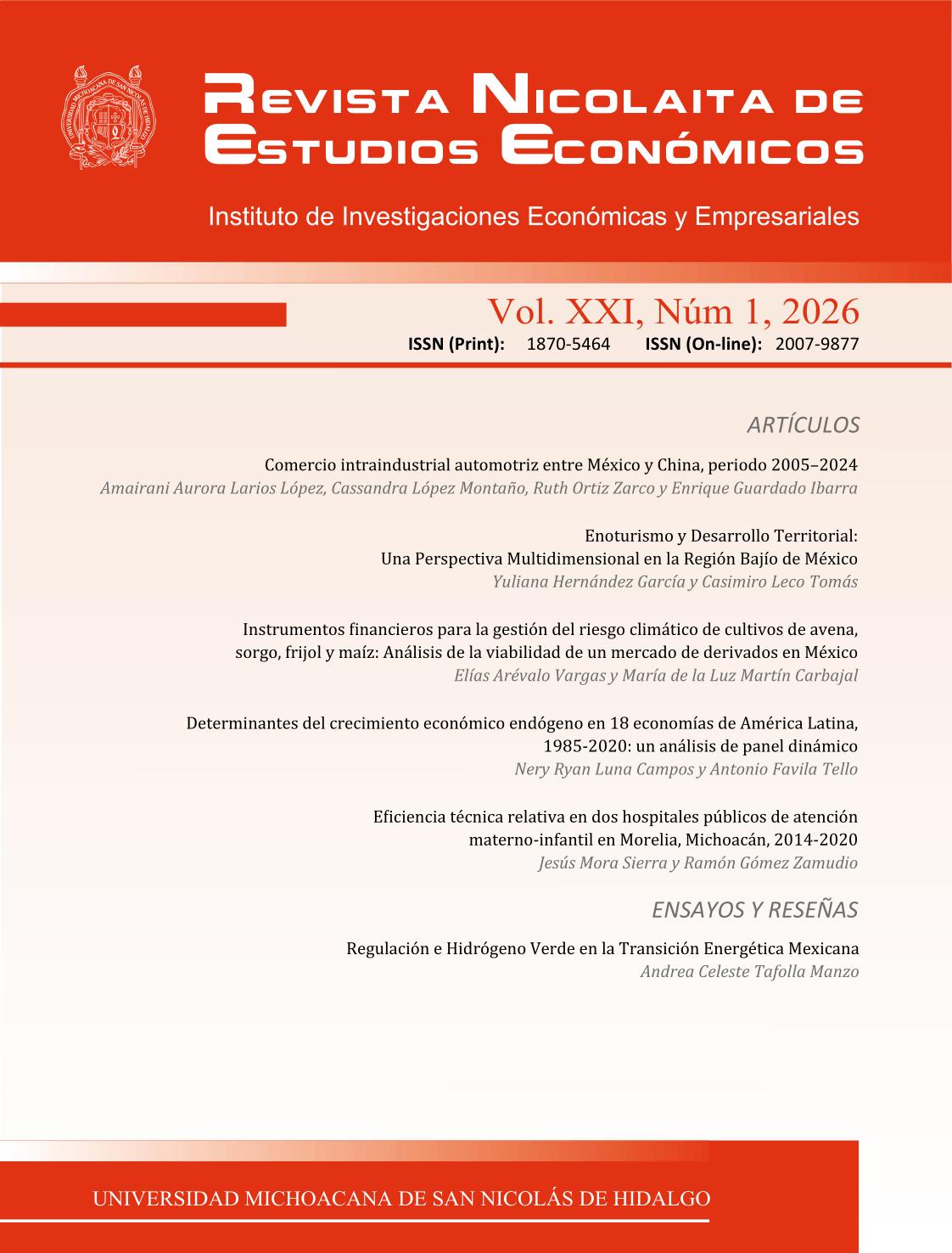
Determinants of endogenous economic growth in 18 Latin American economies, 1985-2020: a dynamic panel analysis
DOI:
https://doi.org/10.33110/rnee.v21i1.384Keywords:
Latin America, Endogenous growth, exports, generalized method of moments, investment rateAbstract
Economic growth in Latin America faces structural challenges that hinder its sustainability. This study analyzes the determinants of endogenous growth in 18 economies of the region between 1985 and 2020, using a dynamic panel model estimated through the generalized method of moments in difference and system forms. The results indicate that average schooling, exports, and infrastructure positively affect growth, while initial GDP per capita, public expenditure, and the investment rate have negative effects, revealing growth patterns that differ from those proposed by traditional models.
Downloads
References
Alemu, S., Beáta , U., & Balázs , K. (2024). Income convergence in Central and Eastern Europe: Evidence from cross-country panel data analysis. AKJournals, 329-257. Arellano , M., &
Bond, S. (1991). Some Tests of Specification for Panel Data: Monte Carlo Evidence and an Application. Review of Economic Studies, 277–97.
Arellano, M., & Sthepen , B. (1991). Some Tests of Specification for Panel Data: Monte Carlo Evidence and an Application to Employment Equations. The Review of Economic Studies, 277-297.
Arrellano, M., & Bover, O. (1995). Another look at the instrumental variables estimation of errorcomponent models. Journal of Econometrics, 29-51. Barro , R., &
Sala-i-Martin, X. (2009). Crecimiento económico . Barcelona:
Reverté . Barro, R. (1991). Economic Growth in a Cross Section of Countries. The Quarterly Journal of Economics, 407-433.
Barro, R. (1998). Government Spending in a Simple Model of Endogeneous Growth. Journal of Political Economy, 1-29.
Cabrera, C. (2014). El concepto y la visión del desarrollo como base para. Economía y sociedad, 47-64. CEPAL. (14 de Diciembre de 2011). En busca de una asociación renovada entre América Latina y El Caribe y la Unión Europea. Obtenido de http://www.eclac.cl/publicaciones/xml/0/43260/En_busca_asociacion_renovada_Ameri
Dar, A., & Amir Khalkhali, S. (2002). Government size, factor accumulation, and economic growth: evidence from OECD countries. Journal of Policy Modeling, 679-692.
Delbianco, F., Dabús, C., & Caraballo, M. (2014). Income inequality and economic growth: New evidence from Latin America. Cuadernos de economía , 381-398.
Forbes, K. (2000). A Reassessment of the Relationship Between. American Economic Review, 869-887.
Gómeza, L., & Flaquerb, J. (2024). Corrupción, crecimiento e instituciones: ¿existe una tasa de sacrificio en américa latina? Revista Latinoamericana de Economía, 3-34.
Hansen , L. (1982). Large Sample Properties of Generalized Method of Moments Estimators. Econometrica, 345–368. Hansson , P., &
Henrekson, M. (1994). A New Framework for Testing the Effect of Government Spending on Growth and Productivity. Public Choice, 1-31.
Huang, C.-Y., Lai, C.-C., & Paretto, P. (2025). Public R&D, private R&D and growth: A Schumpeterian approach. Journal of Economic Behavior & Organization, 1-43.
Jones, C. (2022). The past and future of economic growth: A semi-endogenous perspective. Annual Review of Economics, 1-24.
Kremer, M., Willis, J., & You, Y. (2021). Converging to convergence. Becker Friedman Institute, 1-50.
León, S., Muller , N., & Rodriguez , D. (2024). The endogeneity of the natural rate of growth in Latin America. Revista Mexicana de Economía y Finanzas, 1-12. Loungani, P., & Ostry, J. (24 de Febrero de 2017). Fondo Monetario Internacional . Obtenido de https://blog-dialogoafondo.imf.org/?p=7151
Lucas, R. (1988). On the mechanics of economic development . Journal of monetary economics , 3-42.
Ostry, J., Berg, A., & Tsangarides , C. (2014). Redistribution, Inequality, and Growth. I M F S T A F F D I S C U S S I O N N O T E , 4-27.
Pozzolo, A. F. (2004). Endogenous growth in open economies: a surveys. Bank of Italy, Economic Research Department, Temi di discussione, 7-40.
Ram, R. (1986). Government Size and Economic Growth: A New Framework and Some Evidence from Cross-Section and Time-Series Data. American Economic Review, 191-203.
Rebelo , S. (1991). Long-Run Policy Analysis and Long-Run Growth. The Journal of Political Economy, 500-521.
Romer, P. (1986). Increasing Returns and Long-Run Growth. The Journal of Political Economy, 1002-1037.
Saba, C., & Monyela, M. (2024). Trade openness, economic growth and economic development nexus in South Africa: a pre- and post-BRICS analysis. Humanit Soc Sci Commun, 1-18.
Sala-i-Martin, X. (2002). Apuntes de crecimiento económico. Barcelona : Antoni Bosch. SELA. (14 de Diciembre de 2012). Desarrollo productivo e industrialización. Obtenido de http://www.sela.org/media/3201002/t023600004953-0-desarrollo_productivo_industrializacion_alc.pdf
Suárez, D., & Yoguel, G. (2020). Latin American development and the role of technology: an introduction. Taylor & Francis Journals, 661-669.
Thach, N., & Lopo, J. M. (2021). How have NESTs grown? Explanations based on endogenous growth theory. Cogent Economics & Finance, 1-22.
Tsaurai, K., & Ndou, A. (2019). Infrastructure, Human Capital Development and Economic Growth in Transitional . Comparative Economic Research. Central and Eastern Europe, 33-52.
Venturini, F., & Parello, C. (2025). Knowledge Gaps, Convergence and Growth. SSRN, 1-44.
Xu, Y., Guo, J., & Selvaratnam, D. (2024). The Effect of Average Years of Schooling on GDP Per Capita. International Journal of Social Science and Human Research, 4091-4096.
Young, A. (1991). Learning by doing and the dynamic effects of international trade. Quarterly Journal of Economics, 369-405.
Ziesemer, T. (2024). Evidence on an endogenous growth model with public R&D. Economics of Innovation and New Technology, 536-572.
Downloads
Published
How to Cite
Issue
Section
License

This work is licensed under a Creative Commons Attribution-NonCommercial-NoDerivatives 4.0 International License.